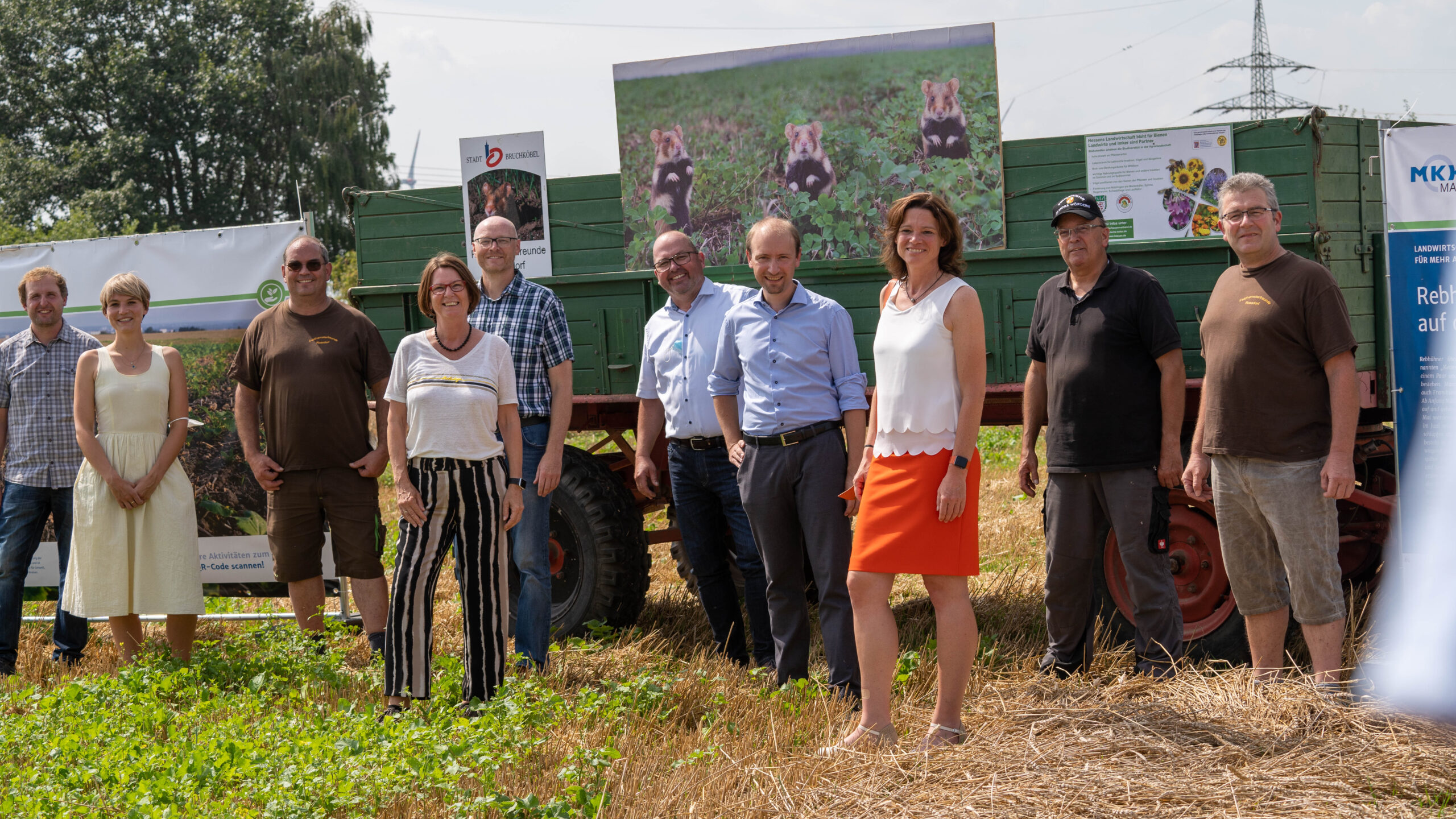
Hinz: “We want to offer field hamsters a home in Hesse in the long term.”
‘Areas and fields are important habitats for animals and plants. However, living conditions for native species have deteriorated significantly in recent decades. Once widespread species such as the field hamster have become extremely rare and threatened with extinction. It is our task and responsibility to reverse this trend and protect biodiversity in the field", explained Environment Minister Priska Hinz during her summer tour, which this year focuses on ‘Agriculture and nature conservation’.
New combination of flowering areas, fallow land and cereals tested
During her visit, the Minister looked at a new combination of measures successfully tested by local farmers: Flowering areas, fallow land as well as the cultivation of cereals and alfalfa (also called eternal clover) were coordinated and merged in such a way that the field hamster finds everything in food and hiding in the smallest space. This means that he no longer has to cover long distances over partially harvested fields without protection, which significantly improves his chances of survival. The experience gained by the participants in this field trial is helpful for all further field corridor projects in Hesse.
The field corridor project in the Mainz-Kinzig district
The project participants in the Main-Kinzig-Kreis focus on the field hamster. Farmers in particular stand by the hamster in the Main-Kinzig district. There are many project participants and there is talk of this, so that the ‘Feldhamsterfreunde Bruchköbel Roßdorf’ initiative has joined forces in the region and is advertising among the population for the protection of the threatened field hamsters.
"The project shows that agriculture and nature conservation can achieve a lot together. We want to take the successful solutions even further and have launched the information campaign “Feldliebe”. The more people learn about the endangered species in the field, the more support we can gain. Only together can we ensure the preservation of biodiversity," the minister said at the end of the meeting.
Background Field projects and financing:
Since 2018, the Hessian Ministry of the Environment has been promoting the protection of species in the field and arable land with so-called field-floor projects. 500,000 euros per year are spent on human resources, project organisation and action planning. The first five field-floor projects in the regions of Wiesbaden, Main-Kinzig, Wetterau, Limburg and Bad Zwesten started in 2018. In 2019, further projects followed at Gießen, Groß-Gerau and in the Hochtaunuskreis. Fulda marks the start of another field corridor project, which will be officially opened today as part of the Hessian Minister of the Environment's summer tour.
In addition to supporting field-floor projects, the Hessian Ministry of the Environment provides 30 million euros annually for environmental and climate protection measures as part of the Hessian agri-environmental programme HALM. In this way, various measures such as the planting of flowering strips, arable margin strips or arable wild herb areas are promoted. A further 30 million euros per year are available for organic farming, which also makes an important contribution to the preservation of biodiversity with its sustainable agriculture.
With the information campaign ‘Feldliebe’, the Hessian Ministry also clarifies the protection of species in the field corridors, encourages participation and informs about the diverse flora and fauna that are part of our cultural landscape. Citizens can become involved in sponsorships or participate in field hamster mappings offered through the HGON.
Further information about the field floor projects and the information campaign Feldliebe: www.feldliebe.hessen.de
 English (UK)
comment article